Six Figures on an AI Chatbot and Nobody Used It
A European chemical distributor spent six figures on an AI chatbot. The technology worked. Nobody used it. Here's why generic AI fails in specialized B2B - and what actually works.

Key Takeaways
- Generic AI chatbots fail in specialized B2B because the questions aren't search problems - they're reasoning problems
- Sales reps in technical industries don't ask well-structured queries. They ask "What should I recommend?" - and answering that requires domain knowledge
- The solution isn't better search. It's AI that understands your specific business context
- Companies that build domain-specific AI workflows outperform those throwing money at generic tools
Farid Mirmohseni, founder of Kimia, shared a story on LinkedIn recently that I keep thinking about.
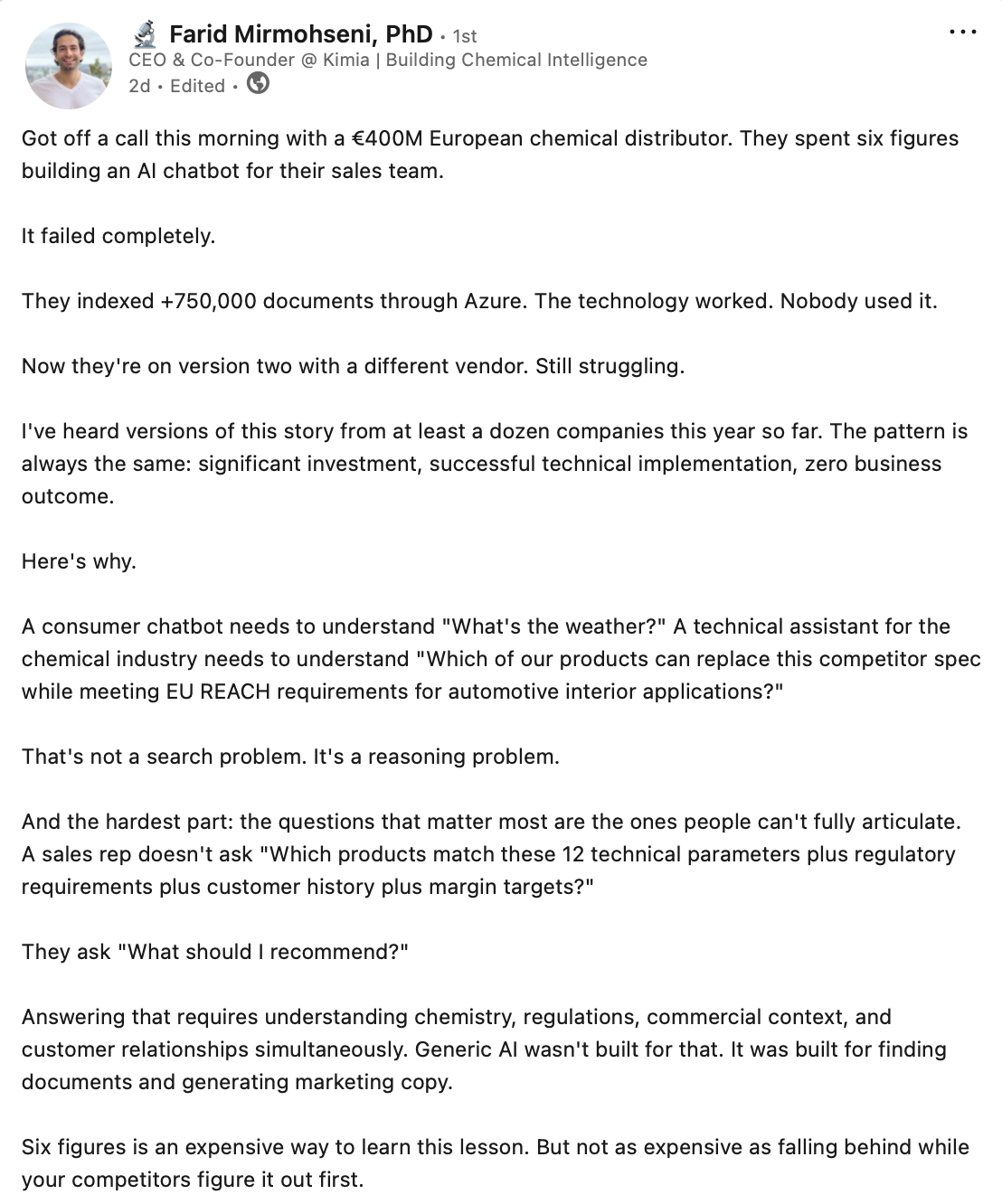
If you don't want to read the full LinkedIn post from Farid: a European chemical distributor spent six figures on an AI chatbot. The technology worked. Nobody used it. And Farid has heard this story from at least a dozen companies this year.
I've heard it too. Different industries, different companies, same outcome. Big investment, successful technical implementation, zero business result.
This is the most expensive lesson in B2B right now. And most companies are still learning it the hard way.
It's Not a Search Problem
Here's where most companies go wrong. They look at their sales team struggling to find information across hundreds of thousands of documents and they think: we need better search.
So they buy an AI chatbot. They index everything. The technology works. It can find any document in seconds.
But nobody uses it. Why?
Because as Farid puts it: a consumer chatbot needs to understand "What's the weather?" A technical assistant for the chemical industry needs to understand "Which of our products can replace this competitor spec while meeting EU REACH requirements for automotive interior applications?"
That's not a search problem. That's a reasoning problem.
And the hardest part - the questions that matter most are the ones people can't fully put into words. A sales rep doesn't ask "Which products match these 12 technical parameters plus regulatory requirements plus customer history plus margin targets?" They ask "What should I recommend?"
Answering that requires understanding chemistry, regulations, commercial context, and customer relationships all at the same time. A chatbot sitting on top of a document database can't do that. No matter how many documents you index.
I See This Pattern Everywhere
I work as a fractional Chief Commercial Officer for biotech ingredient companies. I also help European B2B companies integrate AI through opencream.ai. So I sit right at the intersection of these two worlds - specialized industries and AI implementation.
The pattern Farid describes is everywhere. Not just in chemicals. In specialty ingredients, in biotech, in precision manufacturing. Any industry where the knowledge required to make good decisions lives in people's heads rather than in documents.
I know companies where the best salesperson has 25 years of customer relationships stored in their memory. They know that Customer A's formulation chemist prefers technical data sheets over marketing materials. That Customer B's procurement team always pushes back on price in Q3 because of budget cycles. That the competitor showed up at Customer C last month with a new product that's cheaper but has stability issues.
None of that is in any document. And no chatbot will ever find it by searching PDFs.
The Real Cost of Getting This Wrong
Six figures is painful. But the real cost is bigger than the invoice.
Every failed AI project creates internal resistance. The sales team tried the chatbot, it didn't help, and now they're skeptical about any AI tool. "We tried that already. It didn't work."
That skepticism is hard to undo. And it's usually directed at AI in general, not at the specific approach that failed. So the next time someone proposes an AI solution that might actually work, they're fighting an uphill battle against the memory of the chatbot that nobody used.
I've sat in those meetings. "We spent X on AI and got nothing." The room goes quiet. The topic changes.
Meanwhile, competitors who got the approach right are pulling ahead. Not because they have better AI. Because they understood what kind of AI their business actually needs.
What to Build Instead
The companies I've seen succeed with AI in specialized B2B all share something in common. They don't start with the technology. They start with the decision.
What specific decision are we trying to make better?
For a raw material supplier, it might be: "Which product should I recommend to this customer for this application?" For a biotech company: "What's the right pricing strategy for this market?" For a manufacturer: "Which prospects should we focus on this quarter?"
These aren't search queries. They're judgment calls that require combining multiple types of knowledge - technical, commercial, relational, regulatory.
Here's what works:
Start with one workflow, not the whole company. Don't try to build an AI assistant for everything. Pick the one decision that costs the most time or money when it's wrong. Build AI around that specific workflow.
Capture the knowledge that's in people's heads. The most valuable information in a specialized B2B company is never in documents. It's in the experience of your best people. Before building any AI tool, figure out how to extract and structure that knowledge.
I'm building an agentic CRM for startup B2B raw material suppliers for exactly this reason. These are small teams - often 5 to 15 people - selling specialty ingredients into long sales cycles of 12 to 24 months. They can't afford the enterprise AI solutions that companies like Kimia build for large distributors. But they still need a system that remembers context across months, not just finds documents. That the key contact switched projects. That the competitor's product had stability issues. That procurement review happens next month.
Make it useful on the first day. The chatbot failed because nobody saw the value quickly enough. If your AI tool requires the sales team to change how they work before they see any benefit, it won't get adopted. The best implementations save time from day one, then get smarter over time.
Keep humans in the loop. This isn't about replacing your best salesperson's judgment. It's about making sure everyone on the team has access to the kind of context that your best salesperson carries in their head. AI as an amplifier, not a replacement.
The Window Is Closing
There's something that bothers me about the European B2B companies I work with.
The best people in these companies - the ones with 20 or 30 years of domain knowledge - are getting closer to retirement every year. That knowledge is walking out the door. Slowly, but it's happening.
Companies that figure out how to capture that expertise and multiply it with AI will have a serious advantage. Companies that spend six figures on chatbots and get nothing will waste the window.
Farid is right when he says six figures is an expensive way to learn this lesson. But not as expensive as falling behind while competitors figure it out.
The good news: you don't need six figures to start. You need clarity about which decisions matter most in your business, and the willingness to build AI around those decisions instead of around a document database.
If you're a specialized B2B company trying to figure out where AI actually fits, that's what we help with at opencream.ai. We start with your specific workflows, not with generic technology.
Because in specialized industries, generic doesn't work. Your business is specific. Your AI should be too.
Matthias Forster is the founder of opencream.ai, where he builds AI tools for startup B2B companies, and opencream.partners, where he serves as fractional Chief Commercial Officer for biotech and specialty ingredient companies. Kimia builds chemical intelligence for large manufacturers and distributors. opencream.ai focuses on the smaller players - the startup raw material suppliers and niche champions who need smart AI but don't have enterprise budgets.
FAQ
Most B2B chatbots are built as search tools - they find documents based on queries. But in specialized industries, the questions that matter aren't search problems. They're reasoning problems that require combining technical knowledge, customer context, regulatory requirements, and commercial judgment. A chatbot can't reason across all of those at once.
The amount matters less than the approach. Six figures on a generic chatbot produced nothing. A focused investment in one specific workflow - like customer meeting preparation or product recommendation - can produce results in weeks. Start small, prove the value, then expand.
A chatbot answers questions based on a document database. An AI agent can reason, remember context over time, combine multiple sources of knowledge, and take actions. For specialized B2B with long sales cycles and complex decisions, agents are far more useful than chatbots.
Start with the decision that costs you the most when it's wrong. Talk to your best salespeople about what they wish they had at their fingertips during customer meetings. That's usually where the highest value AI sits - not in replacing people, but in giving everyone access to the knowledge your best people already have.
No. The 400-million-euro distributor had the budget for a big mistake. Smaller companies actually have an advantage here because they can move faster and build focused solutions. A 10-person team with the right AI workflow can outperform a 50-person team using generic tools.
Want to see what AI can do for you?
Tell us about your business. We'll get back to you within 24 hours.
Schedule a Strategy Call